
Turn a Short Soundwalk Into an Audio Piece
Choose a route with a listening question
A soundwalk can begin on a route you already know: a path between buildings, the edge of a park or the journey to a nearby shop. Familiarity is useful because it allows you to notice what normally disappears into the background. Choose a question before recording. Where does the space change acoustically? Which repeated sound makes the route recognisable? What remains audible after you stop moving?
Keep the route short enough to revisit. This is an exercise in attention and editing, not a search for the most spectacular location. You can make an interesting piece from ordinary transitions: an open area becoming enclosed, traffic fading behind a wall or footsteps changing on another surface. The relationship between sounds can provide a structure before any music is added.
Listen before reaching for the recorder
Stand somewhere appropriate and identify the layers you can hear. Notice nearby events, distant background and sounds made by your own movement. The National Park Service treats soundscapes as meaningful features of places and offers listening activities that draw attention to their different components. [1] You can apply that attention to an everyday route without claiming that every recording is a scientific survey.
Write a few descriptive words before pressing record. They provide a useful comparison later, because the recorder may emphasise different features from those you noticed in person. If wind or handling noise dominates the playback, you have learned something about the recording conditions. The task becomes adjusting the setup or choosing another position, rather than assuming the location contained nothing worth hearing.
Gather separate observations
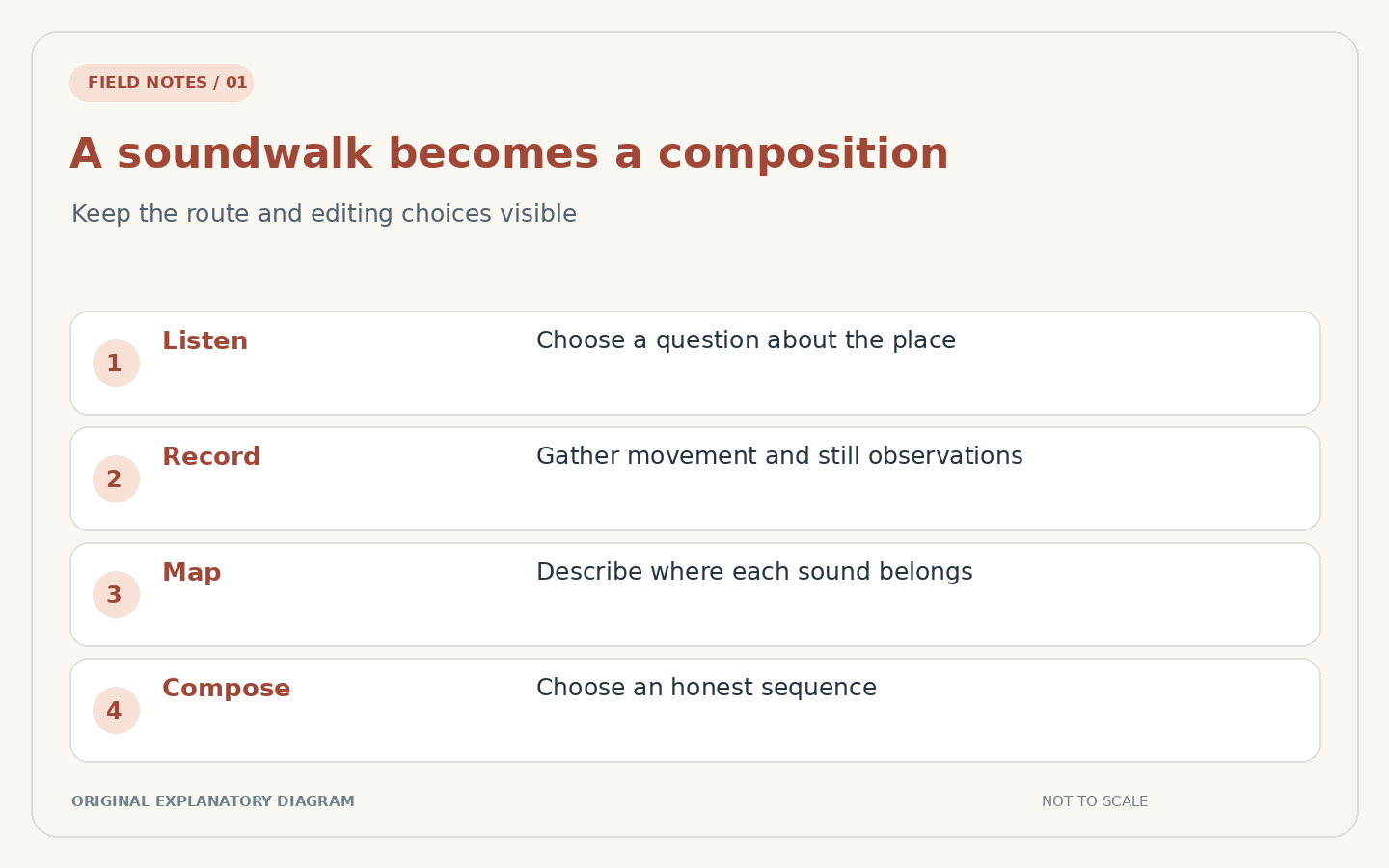
Record stationary moments as well as movement between them. A still recording can make a recurring sound easier to distinguish, while a moving recording conveys the changing relationship between spaces. Leave enough material around an event to understand what preceded and followed it. A clip cut immediately at the interesting sound may be difficult to place naturally in an edit.
Respect the setting and the people in it. Avoid recording private conversations as incidental texture, and do not enter restricted areas for a better sound. If a person becomes an identifiable subject, discuss the intended use and obtain appropriate permission. You can often capture the character of a place through nonverbal details without making someone else’s private exchange part of your artwork.
Make a listening map afterward
On returning, list the recordings in the order they were made and identify one useful feature in each. Use plain descriptions: a door followed by a change in room tone, footsteps crossing a different surface, or a distant machine becoming clearer. Add uncertainty when necessary. A sound you cannot identify should remain unidentified until you have evidence, even if a confident label would make the piece easier to narrate.
Then draw the route as a sequence of listening positions. The map does not need geographic precision; it needs to preserve the relationship among the recordings. Mark where you changed position and where the acoustic impression changed. This makes it easier to decide whether the final piece follows the route or deliberately rearranges it into a different composition.
Build one version around distance
For a first edit, try moving from distant sounds toward closer ones, or from dense surroundings toward a quieter interval. This gives the listener a clear organising principle. You can keep the original chronology or explain that the sequence has been composed from separate moments. What matters is whether the piece presents itself honestly as a continuous walk, a collage or a mixture.
Use transitions that serve the intended relationship. A gradual overlap can connect spaces, while a direct cut can make a contrast noticeable. Listen for whether the transition suggests that events happened together when they did not. That may be a legitimate artistic choice, but it should be considered rather than introduced accidentally through an attractive editing effect.
Separate technical cleanup from composition
First identify problems that obscure the chosen material, such as a handling bump or an abrupt accidental cut. Then decide which changes are artistic: filtering, repeating, reversing or stretching a sound. Keeping those decisions separate helps you understand what the processing contributes. It also makes it easier to return to a simpler version if the treatment obscures the relationship that originally interested you.
Avoid processing every clip merely because the tools are available. A repeated event may become a rhythm without much intervention. A quiet background may give the listener space to recognise another sound. The useful question is what each operation makes more audible or more meaningful. If you cannot describe its purpose, bypass it and compare the result before keeping it.
Give the listener an accessible way in
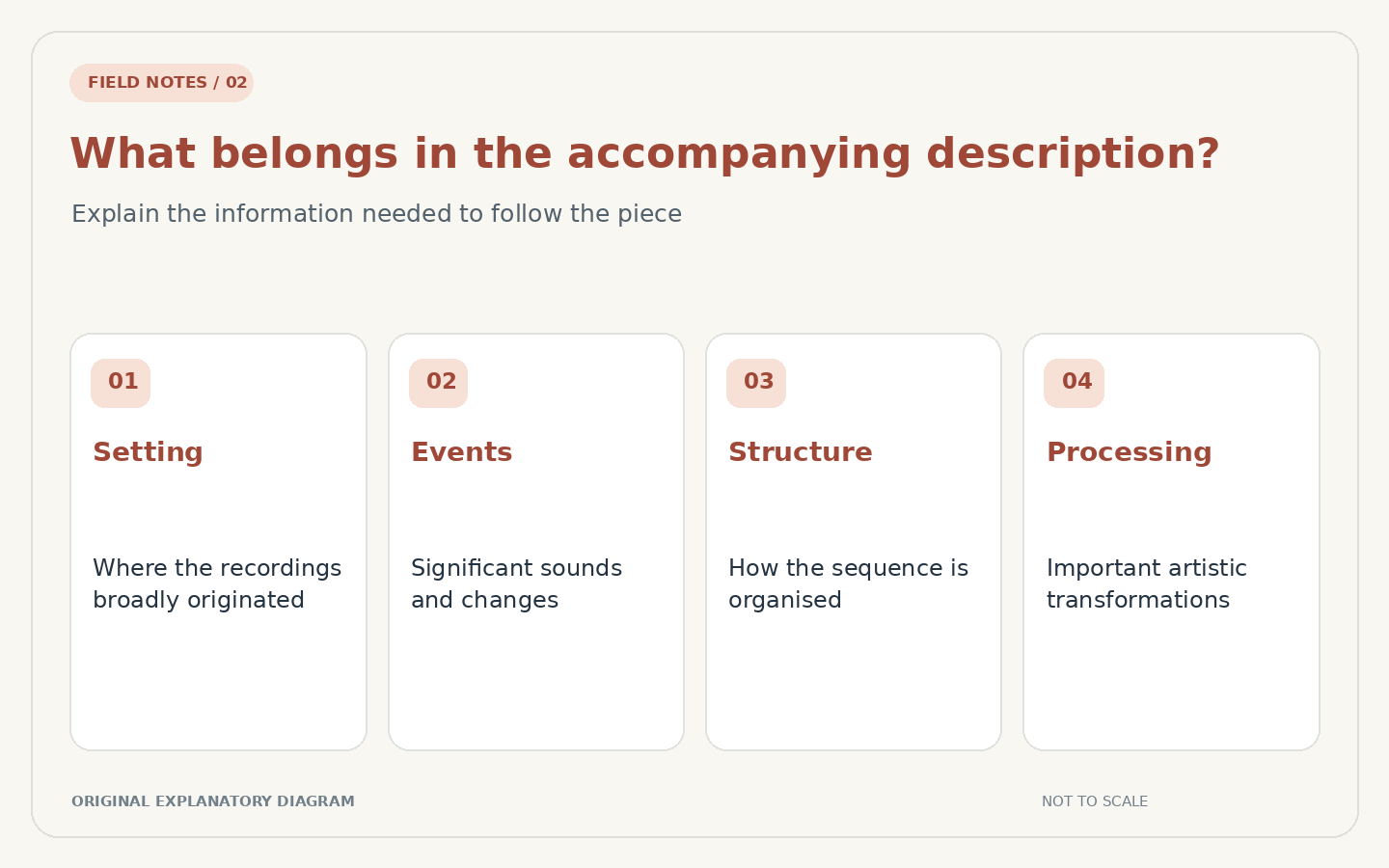
An accompanying text can identify the location in general terms, describe the structure and explain significant editing choices. W3C’s guidance on transcripts includes meaningful non-speech audio information as well as words. [2] For a sound piece, that means describing important events and relationships rather than providing only a blank transcript because nobody speaks.
Keep the description useful without pretending that prose reproduces every sonic detail. You might note a low mechanical background, a series of close footsteps and a transition into a more enclosed space. If the sound’s identity is uncertain, preserve that uncertainty. A descriptive text can also help listeners decide whether the piece contains sudden sounds they would prefer to approach carefully.
Compare the edit with the original question
Return to the question you wrote before recording. Did the piece reveal where the environment changes, or did a different relationship become more interesting? Either outcome can be productive. Write a short note explaining what the finished work now asks the listener to notice. This note can guide the title and prevent an elaborate description from promising a different experience than the piece actually provides.
Ask a listener where they imagined themselves during the sequence. Their answer may reveal an unclear transition or an effective sense of distance. Do not treat a different interpretation as automatically wrong. Decide whether the difference matters to the work’s purpose. A documentary soundwalk and an abstract composition invite different expectations, even when they begin with the same recordings.
Keep the source and the version together
Save the original recordings, the editing project and the finished export with a simple description of the route and the changes made. Include permissions and source information where relevant. A future version may depend on a detail that seems unimportant now, such as which recording contains an unprocessed background or which clip was made in a different place.
The completed piece is one result; the new listening habit is another. On the next walk, you may hear transitions that previously passed unnoticed. That is enough reason to repeat the exercise. A small audio project becomes richer when its sounds remain connected to the places, decisions and attention that produced them, rather than becoming anonymous material inside an effects chain.
Sources
- Enhance Your Soundscape — US National Park Service
- Transcripts: Making Audio and Video Media Accessible — World Wide Web Consortium
Post Author: William Henders
